Here’s something most people don’t realize: you can catch malaria dozens of times and still never become fully immune. Repeated infections gradually reduce the risk of severe disease, but they rarely prevent the next infection. The immune system learns to control malaria without ever truly defeating it.
Can we develop a malaria vaccine?
Vaccines work by giving the immune system a preview of a disease-causing organism. They expose it to a harmless piece of a pathogen, building immune memory before the real threat appears. When it does, the immune system responds quickly, often stopping the infection before it causes disease. This strategy has protected millions of people from illnesses such as smallpox, polio, and measles.
Malaria is different. The parasite changes dramatically as it moves through different stages of its life cycle, making it much harder for the immune system to recognize and remember.
So the question of malaria vaccine research became: if “out-in-the-wild” infection could not provide complete protection, how could a vaccine?
Why is malaria so difficult to recognize?
Malaria is caused by Plasmodium, a single-celled parasite transmitted through the bite of an infected mosquito. During each stage of its life cycle, the parasite displays a different set of proteins, so immune responses that recognize one stage of the parasite may not recognize the next. For much of its time in the body, the parasite is also hidden inside our own cells, making it difficult for the immune system to reach.
These changes help explain why immunity to infection is incomplete. The immune system gradually learns to reduce the severity of malaria, but it struggles to build the kind of long-lasting protection that prevents future infections. The challenge in developing a vaccine was not simply finding a parasite protein to target. It was understanding which immune responses actually protected against malaria, and when they needed to act.
How do you teach the immune system where to look?
More than 60 years ago, experiments first showed that malaria could be stopped before it multiplied inside the body. Turning that insight into a practical vaccine, however, proved far more difficult.
When an infected mosquito bites, it injects only a small number of parasites, called sporozoites, into the skin. Their one goal is to reach the liver. If even a single sporozoite reaches the liver, it can multiply into tens of thousands of parasites before they are released into the bloodstream, where they then invade red blood cells, cause disease, and can eventually be picked up by another mosquito. This means there is only a narrow window to stop the infection before it takes hold.
The first malaria vaccine, RTS,S, is designed to take advantage of that opportunity. It trains the immune system to recognize a protein on the surface of sporozoites. Researchers strengthened this response by combining the malaria protein with a part of the hepatitis B virus, that doesn’t cause disease on its own. This helped the immune system generate a stronger antibody response against the malaria target. Those antibodies are then waiting when an infected mosquito bites, giving the immune system the best chance to stop the parasite before it reaches the liver.
In 2021, the World Health Organization recommended RTS,S for widespread use in children. It was the first vaccine against a human parasite to be introduced into routine immunization.
What can an imperfect vaccine achieve?
The first malaria vaccine is far from perfect. It does not prevent every infection, protection decreases over time, and vaccinated children still need insecticide-treated bed nets, rapid diagnosis, and effective treatment.
Even so, the first malaria vaccine showed that vaccination against malaria was possible.
A study published this year in The Lancet evaluated RTS,S’s first routine use in Ghana, Kenya, and Malawi. An important part of this study was that the researchers did not focus only on deaths attributed to malaria. Instead, they asked a broader question: did fewer children die overall after the vaccine was introduced? The answer was yes—and the reduction was substantial.
Researchers found that introducing the vaccine prevented about one in eight deaths among young children eligible for vaccination.
RTS,S does not provide complete protection, but it demonstrates an important principle of vaccinology: a vaccine does not need to prevent every infection to have a major public health impact.
It took more than 60 years for scientists to develop the first vaccine against a human parasite, and its success is already informing the development of even better ones. This achievement shows how decades of research to understand the immune system can translate into saving lives. Today, that knowledge is helping thousands of children live longer, healthier lives.
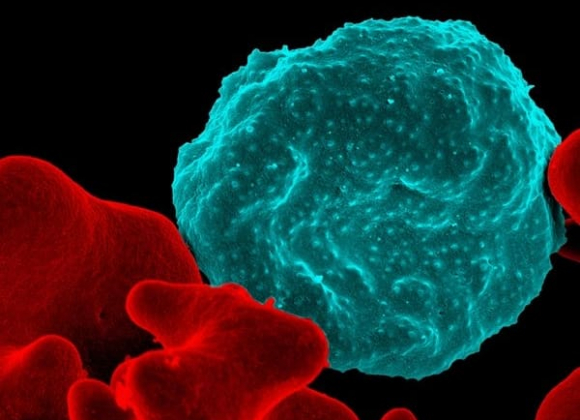
Image of red blood cell infected with malaria parasite from National Institute of Allergy and Infectious Diseases (NIAID)/Rocky Mountain Laboratory
Dr. Götz is a translational immunologist at Seattle Children’s Hospital studying human immune responses to malaria.