Over 55 million people globally suffer from dementia, with this number projected to grow to 139 million people by 2050. Alzheimer’s disease (AD), the most common type of dementia, is a neurodegenerative disease where plaques and tangles build up in the brain leading to problems with memory, cognition, speech, and daily functioning. Its damage is irreversible and there is no cure as of this writing.
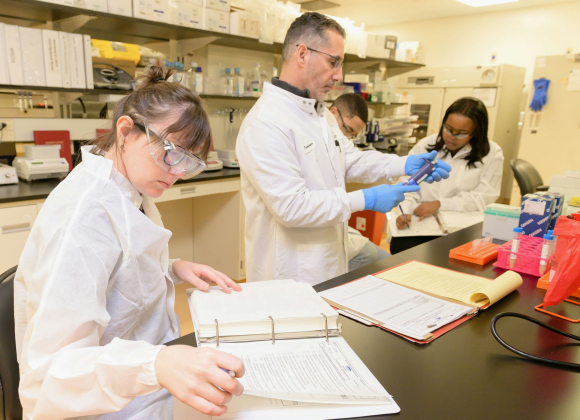
Scientists like myself and others at Indiana Biosciences Research Institute (IBRI), are working to discover new treatments for AD. I am part of a collaborative team known as TREAT-AD (TaRget Enablement to Accelerate Therapy development for Alzheimer’s Disease) that is working to expand the AD drug discovery pipeline. We are one of two branches of TREAT-AD, composed of brilliant researchers from Indiana University School of Medicine, Purdue University, and IBRI.
Within TREAT-AD, four teams work together to research new ideas and try to solve the problem of developing new drugs to prevent Alzheimer’s before it becomes a problem. Our Bioinformatics team looks at large subsets of human genomic data to identify trends and genes of interest in the study of AD. The Structural Biology and Biophysics team then takes those genes of interest to assess how they contribute to AD and if they could be a drug target. Next, our Assay Development team designs experiments to test these targets, and our Medicinal Chemistry team will design and create potential drug compounds. These potential drug compounds are then sent to our Assay Development team to further test how they function.
While we know AD is characterized by the development of plaques and tangles in the brain, made up of amyloid beta and tau proteins, we don’t fully know what causes a person to develop them. Most AD drugs target these plaques and tangles for removal, or to slow progression of the disease. So far, drugs have not been able to reverse the damage caused by these plaques. TREAT-AD seeks to address this gap by finding out which mechanisms fail and lead to the development of AD. Figuring out this crucial piece could allow us to better diagnose, target, and treat AD.
Once the potential drug compounds show positive results in cells in the lab, we send them to the MODEL-AD team (Model Organism Development and Evaluation for Late Onset Alzheimer’s Disease) for testing in animal models of AD. The MODEL-AD team develops animal models of Alzheimer’s disease, to better identify the mechanisms leading to AD, as well as to determine the effects of the potential drug compounds outside the brain.
For example, if we designed a compound that prevented the accumulation of bad tau protein in the brain, but the compound was also toxic to the kidneys, it would not be a drug we could use because it harmed the patient. Through the collaboration of MODEL-AD and TREAT-AD research groups, we are better able to test the preclinical efficacy of our potential drug compounds, as well as rapidly alter and improve them should there be any negative effects. This research system sets us up for the best chance of success at creating new drugs to treat AD, and is publicly available on the AD Knowledge Portal. By making the research open, we hope to accelerate AD research to one day create a prevention or cure of AD.
Dr. Delery is a Staff Scientist in Neuropharmacology at Indiana Biosciences Research Institute and an Adjunct Clinical Assistant Professor at Indiana University School of Medicine.